Grade 1–2Curriculum · Maths
Math Worksheets for Ages 6–8 (grades 1–2)
A ready-made mixed review for grades 1–2, covering numbers to 20, adding and subtracting with simple word problems about apples, balls and toys. Print it or pick a single topic below.
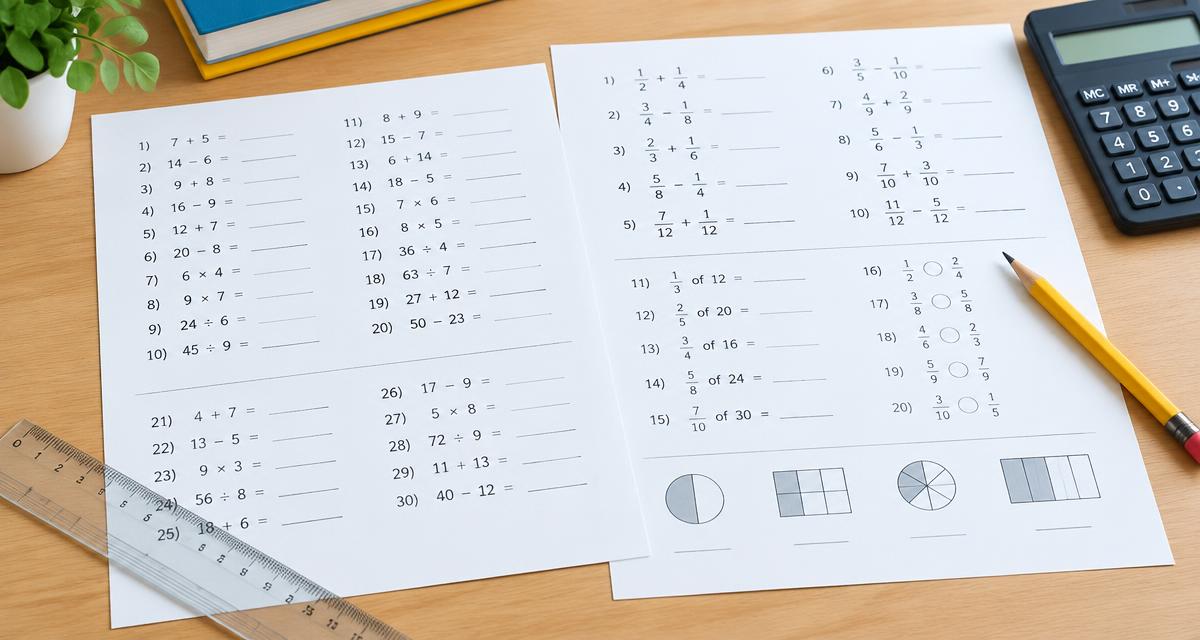
A ready worksheet is waiting below — print it as is or change the settings.
Step 1 of 4
Choose a topic
Your choices
- Exercise type
- Mixed review of all areas
- Age
- 6–8 years
- Difficulty
- Easy
- Number of tasks
- 20
- Task format
- Mixed
- Paper size
- A4
Your choices
- Exercise type
- Mixed review of all areas
- Age
- 6–8 years
- Difficulty
- Easy
- Number of tasks
- 20
- Task format
- Mixed
- Paper size
- A4
More options
Mixed review of all areas · 6-8 years
Name: ____________________Write the number shown in the picture.

Show your thinking:
Sam has 7 apples in a bag. Grandma gives Sam 5 more. How many apples does Sam have now?
Count all the dots: 3 groups of 4. 3 × 4 = __.

Show your thinking:
Share 12 dots equally between 3 empty boxes. How many go in each box? 12 ÷ 3 = __.

Show your thinking:
There are 5 balls in the basket. 2 are taken out at break. How many balls are left in the basket?
Count all the dots: 3 groups of 3. 3 × 3 = __.

Show your thinking:
Share 9 dots equally between 3 empty boxes. How many go in each box? 9 ÷ 3 = __.

Show your thinking:
Write the number shown in the picture.

Show your thinking:
Write the number shown in the picture.

Show your thinking:
Write the number shown in the picture.

Show your thinking:
Calculate: 20 − 7 =
Hugo has 3 apples in a bag. Grandma gives Hugo 3 more. How many apples does Hugo have now?
Omar has 20 stickers and gives 13 to a friend. How many stickers does Omar have left?
Count all the dots: 2 groups of 4. 2 × 4 = __.

Show your thinking:
Calculate: 2 + 7 =
Write the number shown in the picture.

Show your thinking:
Calculate: 5 + 6 =
Share 12 dots equally between 3 empty boxes. How many go in each box? 12 ÷ 3 = __.
Show your thinking:
Elias finds 11 pine cones in the woods and 3 by the path. How many pine cones does Elias find?
Calculate: 2 + 13 =
Answer key
- 1. 23
- 2. 12 apples
- 3. 12
- 4. 4
- 5. 3 balls
- 6. 9
- 7. 3
- 8. 47
- 9. 49
- 10. 41
- 11. 13
- 12. 6 apples
- 13. 7 stickers
- 14. 8
- 15. 9
- 16. 22
- 17. 11
- 18. 4
- 19. 14 pine cones
- 20. 15
How to use the tool
- The page opens a mixed review for this age group.
- Change area, exercise type, level or number of tasks if you like.
- Print or save as PDF; “Create New Version” gives a new sheet.
About this generator
This page collects everything pupils aged 6–8 (grades 1–2) typically practise: numbers to 20, adding and subtracting with simple word problems about apples, balls and toys. The default sheet mixes all areas — addition and subtraction, multiplication and division, number sense, fractions, percent, algebra, geometry and statistics — at a level suited to the age group, so it works well as a weekly review, a diagnostic before a new unit or homework. Switch to a single area to focus on one skill. The answer key is calculated by the website and includes units for every word problem. No sign-up and no personal data.
Popular uses
- Weekly mixed review
- Diagnostic before a new unit
- Homework
- Substitute teacher lessons
Plan a useful printable
Start with one clear learning goal and choose only the settings that support it. A short, focused sheet is often easier to explain, complete and review than a crowded page. The live preview makes it possible to check spacing, task count and difficulty before paper is used. Create another version when a class needs the same skill with different content.
Adapt it to the learner
Use fewer items, larger writing areas and familiar content for beginners. Increase the amount, range or complexity gradually for confident learners. Teachers can also combine the printable with oral instructions, pair work or a short follow-up discussion. Because every page is customizable, the same activity can support a warm-up, independent practice, homework or revision.
Print clearly and reuse
Choose A4 or US Letter to match the printer, then print at 100 percent whenever exact spacing matters. The PDF option uses the browser print dialog and creates a clean file for later use. Generated content is prepared in the browser, requires no pupil account and has no watermark. Review every sheet before sharing it, especially when you add your own words or text.
More math worksheets by topic
- Percentage worksheets
- Fraction worksheets
- Equation worksheets
- Algebra worksheets
- Decimal worksheets
- Time worksheets
- Area and perimeter worksheets
- Statistics worksheets
- Division worksheets
- Subtraction worksheets
- Volume worksheets
- Unit conversion worksheets
- Mean and median worksheets
- Multi-step maths worksheets
- Pythagorean theorem worksheets
- Linear function worksheets
- Proportion worksheets
- Interest worksheets
- Exponent and square root worksheets
- Systems of equations worksheets
- Mixed maths review (ages 14–16)
- Math worksheets grade 1
- Math worksheets grade 2
- Math worksheets grade 3
- Math worksheets grade 4
- Math worksheets grade 5
- Math worksheets grade 6
- Math worksheets ages 8–10 (grades 2–4)
- Math worksheets ages 10–12 (grades 4–6)
- Math worksheets ages 12–14 (grades 6–8)
- Math worksheets ages 14–16 (grades 8–10)
- Weekly math worksheet
Frequently asked questions
- How do I pick the right level?
- Choose an age or grade in step 2. Start easier if the pupil is unsure – you can switch anytime and get new problems instantly.
- Can I see the problems before printing?
- Yes. The sheet shows exactly the problems that will print. Click New problems to swap them.
- How do I include an answer key?
- Turn on Answer key in the last step. It prints on its own page after the problems, with the same numbering.
- What does the question mark next to a problem do?
- It opens a step-by-step explanation of the method on screen. It is not printed and does not reveal the answer.
- What do pupils aged 6–8 practise?
- Typically numbers to 20, adding and subtracting with simple word problems about apples, balls and toys.
- Is there an answer key?
- Yes, printed last, with units for word problems.